loader image

Why we Need to Rethink Collaboration: Lessons from Utrecht

How can people from different parts of the world come together to profoundly change education systems not just on paper, but in real life? That was the big question at the Global Partnerships for Life Skills Education Conference, held in June 2025 at the Utrecht University in the Netherlands. I was lucky to be part of this gathering, where educators, researchers, funders, and policymakers from across Africa and Europe came together. We did not just talk about life skills, we talked about how we work together, who leads, who listens, and how to build partnerships that matter. This was no ordinary conference. It was an open pot of conversations, sometimes hot and uncomfortable, yet full of big ideas about how to shift power, build trust, and make education more meaningful for young people, especially in Africa. Moving Past Old Models of Collaboration One of the most powerful sessions of the conference included a honest conversation about how international partnerships often work and how they need to change. A number of issues, concerns and proposals emerged from these deliberations. One of the concerns that emerged was that, too often, big ideas in education are crafted in Europe or North America, then simply sent over to African countries. Local experts are asked to “adapt” or “implement” these ideas but rarely lead the work themselves. This top-down model is outdated, and frankly, unfair. Secondly, the researchers reminded us that African countries have the knowledge, experience, and creativity needed to lead their own education reforms. Consequently, what they need are equal partners not just donors or advisors. We also spoke about the challenges of working through partnerships. That, different partners often have diverse ways of working. And that sometimes, they may use different terms, have different expectations, or follow different timelines. But these challenges can be solved if there’s clear communication and mutual respect. Funding, Publishing, and the Problem of Recognition. Of course, research hinges on resources. However, getting funding for African-led work remains a challenge. Many global funds still flow through institutions in the Global North, and African organizations often end up as sub-partners instead of leaders. Recent analysis by the Education Sub-Sahara Africa (ESSA) established that, research is grossly under-funded in Africa and accounts for just two percent of the global output, with dismal output level from women and early-career researchers. Only 10 percent of the accessible research is funded, and even this is funded from external sources. The situation constrains research training and progression of young researchers. Publishing is another issue. African researchers struggle to get their work into top international journals. These journals often do not value locally driven or community-based research. To fix this, we discussed setting up our own journals or pushing for special editions in existing ones (those that center African voices and ideas). We also reflected on how research success is often measured using tools like the H-index or impact factor. These were developed in Western academic systems and do not always reflect what is valuable in African contexts. Instead of asking how many papers someone has published, we need to ask the extent to which the work changed lives? The ALiVE Experience and What Lies Ahead. Dr. John Mugo the Principal Investigator of ALiVE presents at the conference For our team at Action for Life Skills and Values in East Africa (ALiVE) initiative, the conference was a great chance to share what we have been doing and to connect with others working on similar goals. We spoke about how we have been collaborating with different stakeholders including government agencies to better understand and nurture life skills and values in our education systems. The sessions gave us innovative ideas on how to move forward. We are now exploring ways to co-author research papers with international partners and even launch peer learning simulations. Most importantly, we came away with a renewed belief that African voices must not just be included, they must lead. A New Way of Working Together In conclusion, one of the things that made this conference different was its spirit. It was not just about networking or presenting research ideas. It was about rethinking how we work together. My key takeaway was that, collaboration is not just about signing agreements or organizing meetings. True collaboration means sharing power, building trust, and creating space for everyone’s voice. It means seeing African partners not as “beneficiaries” but as co-creators. At a time when global funding is shifting and institutions like USAID are pulling back, we need to find new ways to sustainably support each other. That might mean building regional alliances, designing locally funded programs, or simply listening better. The future of education, especially life skills education depends on this. Not just what we teach, but how we come together to make it happen. By David Alelah – Regional MEL Coordinator, ALiVE

ALiVE Academy: Building Regional Scholars and Experts

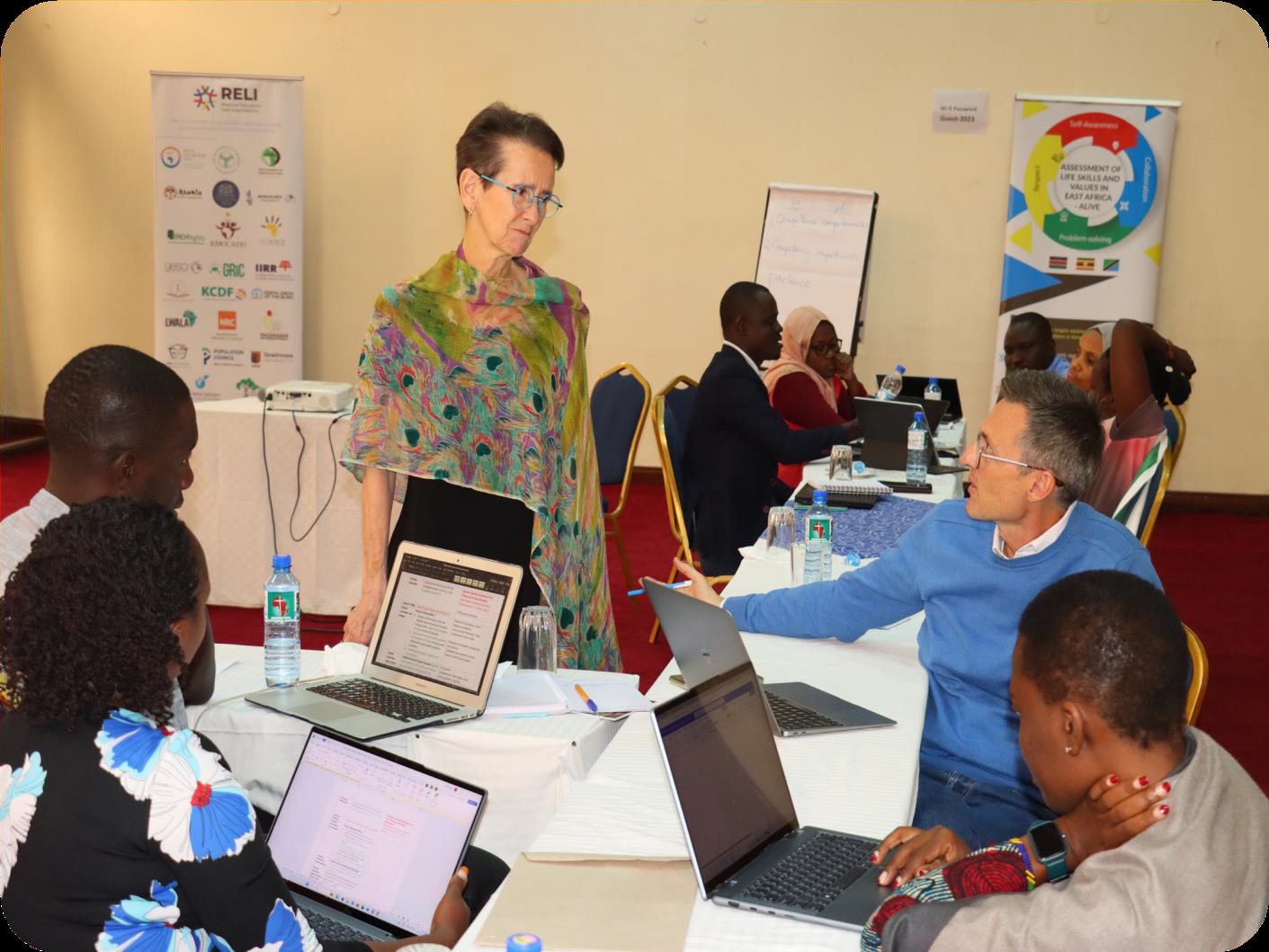
The Action for Life Skills and Values in East Africa  (ALiVE) seeks to generate evidence on life skills and values and use this evidence to engage in public policy reforms, and strengthen local capacities in life skills competences in Kenya, Tanzania mainland, Uganda and Zanzibar. ALiVE responds to the need for RELI Africa members and the education systems to develop assessments of life skills and values within the East African context and collate evidence on what works in nurturing these competences. This is intended to grow the local expertise of RELI Africa members. As the RELI Africa members increase their understanding of these competences, there will be growth of local expertise with hands-on skills in nurturing and measuring complex skills and supporting education systems to better integrate assessments in curricula for improved learning outcomes. The current focus of the ALiVE programme is on enhancing the capacity of the key government education departments to integrate, nurture and assess life skills and values in the national education systems for a wider system shift. This is achieved by collaboratively developing contextualized classroom-based assessments tools for generating evidence-based learning progressions for prioritized competences and supporting the implementation of Values-based Education (VbE) using the Whole School Approach (WSA). The evidence generated will be crucial for developing and trying out interventions for improved education practices and for public policy advocacy ALiVE focuses on three interlinked outcome areas: System shift: Evidence used to inform policy and practice for assessing and nurturing life skills and values. Assessment shift: Assessment capacities for life skills and values strengthened. Learning hub: Evidence on life skills and values enriches internal and external learning. The ALiVE Academy Vision The ALiVE Academy was established during Phase I of the ALiVE programme (2020 to 2023), as a strategic initiative to strengthen national capacities for life skills and values assessment across Kenya, Tanzania (Mainland and Zanzibar), and Uganda. Drawing on a multidisciplinary community of 47 local experts from government, academia, and civil society, the Academy played a central role in co-developing contextualized household-based assessment tools for adolescents aged 13–17 years. While the initial academy developed contextualized assessment measures for skills and values, the Academy was not just about creating assessments; it was about growing local capacity and ownership so that education systems in the region could better nurture the full potential of every young person. Over time, the ALiVE Academy has grown into a vibrant hub for nurturing local expertise and advancing public understanding of life skills and values. It has played a key role in strengthening the capacity of assessment institutions and education systems to integrate, support, and measure these critical competencies. At its core, the Academy supports a broader vision: the establishment of a homegrown African assessment centre, rooted in East Africa and led by local knowledge and leadership. A past session of the ALiVE Academy The training content is directly informed by the mapping and capacity enhancement plans developed under Outcome 1 (System Shift).  Key focus areas include adapting the ALiVE tool for younger learners (6-12 years), transitioning its application from household to classroom settings, and expanding its reach across multiple languages and contexts. The work also involves developing additional tasks and items for the existing competences, as well as designing tools for new competences and values as per country priorities. The second dimension of the academy is finalising the training packages and acquisition of intellectual property rights to safeguard and formalize the tools and resources developed through the ALiVE Initiative. In parallel, the Academy is drawing lessons from established global assessment centres to inform strategies for long term institutionalization and sustainability beyond 2025. To ensure continuity and local ownership, the Academy is pursuing a dual strategy: deepening the capacity of the current cohort of trainers while expanding participation to include additional professionals from partner institutions. The ALiVE Academy has from time to time admitted interested teachers, curriculum development and assessment experts as well as teacher trainers from the jurisdiction in which ALiVE works (Kenya, Uganda, Tanzania mainland and Zanzibar). Additionally, the Academy aims to invite identified and interested members from universities and researchers in each participating jurisdiction as well as members of the RELI Africa/VaLi communities. This approach aims to build a wider pool of experts equipped to lead the life skills and values assessment agenda. ALiVE Academy courses are provided free of charge for the participants who are invited to participate in the various cohorts. Participants are also supported with relevant costs associated with travel, accommodation and other logistics necessary when members are meeting for hybrid or face to face workshops, or when required to go to the field to develop, test or pilot tools. By Dr. Samuel Mutweleli, Regional Assessment Shift Manager – ALiVE @MMutweleli

Discover ALiVE Academy: What You Need to Know.

ALiVE ACADEMY (AA) is a capacity-building arm of the Action for Life Skills and Values in East Africa (ALiVE) initiative. AA is designed as a growth space for local experts developing assessments of life skills and values. The ultimate aim of the AA is to produce a critical mass of experts who can equip assessment institutes, education systems and the education community at large, with the capacities needed to nurture and foster these skills and competencies in children and youth across the region and continent. What is Involved? AA is a space for learning, capacity building, and production of tools and tasks (resources) to be open for use by interested stakeholders. AA is composed of four main cohorts: Cohort 1: A framing series which include exploring and digging deeper into understanding the formation of different frameworks; the purpose of focusing on skills; matters of assessment of skills as part of daily life and as part of curriculum; approaches to developing and adapting tasks; and considerations of the ethical and educational implications of assessment of life skills and values. Cohort 2: School/classroom based assessments: This cohort takes AA members through the process of development or adaptation of assessment tasks and tools for use in the school/classroom. Assessments are developed for both the younger (6-12) and older (13 to 17) age groups as requested by the participating jurisdiction include education systems in Uganda,Tanzania mainland and Zanzibar. Cohort 3: Household based assessments: This cohort involves AA members generating additional assessment tasks for the 13 to 17 age group specific to the skills developed in ALiVE Phase 1, namely problem solving,collaboration, self-awareness and respect. AA members are divided by country groups to focus on an assigned skill or skills. The teams would then share their developed tools to test and administrate pilots of all skills in each country to allow for regional use. The development of more tasks for this cohort allows for the tools to be used to assess and score individual adolescents rather than for producing large-scale results for comparison across different categories. Cohort 4: Data analysis/statistical methods: This cohort involves taking participants through the analysis process of data generated from young people responding to the assessment tasks, once tools have been piloted (with data generated from cohort 2 and 3). Members from each jurisdiction participates in conducting analysis of the data gathered from their respective locations. Who is Involved? All interested members of ALiVE Phase 1 technical team from Kenya, Uganda and Tanzania are invited to participate in the cohorts of the ALiVE ACADEMY. Enrollment in each cohort is contingent on engagement in previous cohorts. The AA also invites interested teachers, curriculum development and assessment experts as well as teacher trainers from the education systems ALiVE is working in. Additionally, AA invites identified and interested members from University and Teacher Training Colleges in each participating jurisdiction as well as members of the RELI/VALI communities. What Format? Given the complexity of conducting training across different countries and at times, different time zones, AA modules across all cohorts will are delivered in a hybrid fashion.While many of the theoretical or framing sessions are done virtually, the more practical and hands on sessions will are delivered on site, face to face (or hybrid) to facilitate participation. This is particularly true for the school/classroom based assessments where task development and validation involve field work activities in classrooms. When / How Often? AA cohorts are conducted at different intervals throughout the year starting September 2023 up to December 2025. Cohort 1 is delivered on a regular basis (likely monthly) with different topics covered based on topics of interest or relevance to the participants. Cohort 2 took place over a period of between 6-12 months depending on spacing of workshops and when the respective systems needed to finalize tools. Cohort 3 took place starting in October 2023 and required a period no less than 3 months to complete; Cohort 3 is repeated in 2024-2025 should more tasks be needed for the repository. Cohort 4 follows cohort 2 and 3 and took place over a period of no less than 3 months. What is required of participants? Participants are expected to be available for all scheduled sessions, and to complete individual and group tasks and activities between sessions. The ALiVE capacity-building is based on collaborative learning and so relies on inputs from all participants. Information about each cohort and its estimated commitment will be available for potential participants prior to their enrolment so that a realistic evaluation of inputs can be made by each individual. What are the Associated Costs? AA courses are provided free of charge for those participants invited to participate in the various cohorts. Participants are also supported with relevant costs associated with travel, accommodation and other logistics necessary when members are meeting for hybrid/face to face workshops or when required to go to the field to develop, test or pilot tools. Who Teaches the Courses? Most of the courses in the ALiVE ACADEMY are delivered by Professor Esther Care from the University of Melbourne in the first instance. Increasingly members of the Academy co-facilitate learning sessions drawing on their local experience. In the peer learning sessions, interested members facilitates topics they have researched. Where necessary and relevant, other teachers will be sourced based on area of expertise What is Awarded? AA provides all participants with certificates of completion of the respective cohort they completed. Participants may be awarded certificates for more than one cohort. Certificates, in the first instance, will be awarded by RELI Africa.